How We Audit Ownership: The Method Behind "Verified Independent"
"Verified independent" is a claim, and a claim is only as good as the checking behind it. This page is that checking, made public, so you can either trust the badge on a listing or run the same check yourself and see if we got it right. We'd rather be corrected than trusted blindly.
What "independent" actually means here
A firm qualifies for the Made Properly directory if it is one of:
- Family-owned — majority equity and board control held by the founding family or their direct successors
- Founder-led — majority equity and control held by the person(s) who started the business, or a management team that bought it back into independence
- Cooperative — genuinely member-owned and governed, not a historical label a company has outgrown
- Independent private ownership — privately held, with no parent company, majority shareholder, or controlling stake held by a corporation, conglomerate, or institutional investor
It does not disqualify a firm to have taken on debt, a minority investment, or a management buyout backed by a bank — the test is who holds majority control and who the profit ultimately flows to, not whether the balance sheet is complicated.
It does disqualify a firm to be a subsidiary of a public company, a conglomerate, a private equity vehicle, or a foreign parent with consolidated financial control — regardless of how the subsidiary markets itself, regardless of whether day-to-day creative direction is left alone, and regardless of how long ago the acquisition happened.
The check itself
For every firm, before it enters the directory and again on a quarterly re-audit, we look at:
- Companies House filings. For UK-registered entities, the Persons with Significant Control (PSC) register is the primary source — it's a statutory requirement, not a press release, and it names whoever holds more than 25% of shares or voting rights. This is the single most reliable source we use, because it's the one the company itself is legally obligated to keep accurate.
- Parent company and subsidiary structures. Where a UK entity is owned by a holding company, we trace that chain upward until we reach either a named individual/family or a public/institutional owner. A firm one legal step away from a family name and three steps away from a conglomerate is still, ultimately, conglomerate-owned.
- Press and trade coverage of the transaction itself. Acquisitions, buyouts, and administrations are reported — trade press (Retail Gazette, The Business Desk, industry-specific outlets), national press for larger deals, and administrators' own progress reports for insolvency cases (EY, Evelyn Partners and similar firms publish these as a matter of process).
- The company's own statements, weighted lowest of the four, because a company's "About" page is marketing, not evidence — useful for corroboration, never sufficient on its own.
Four grades of evidence
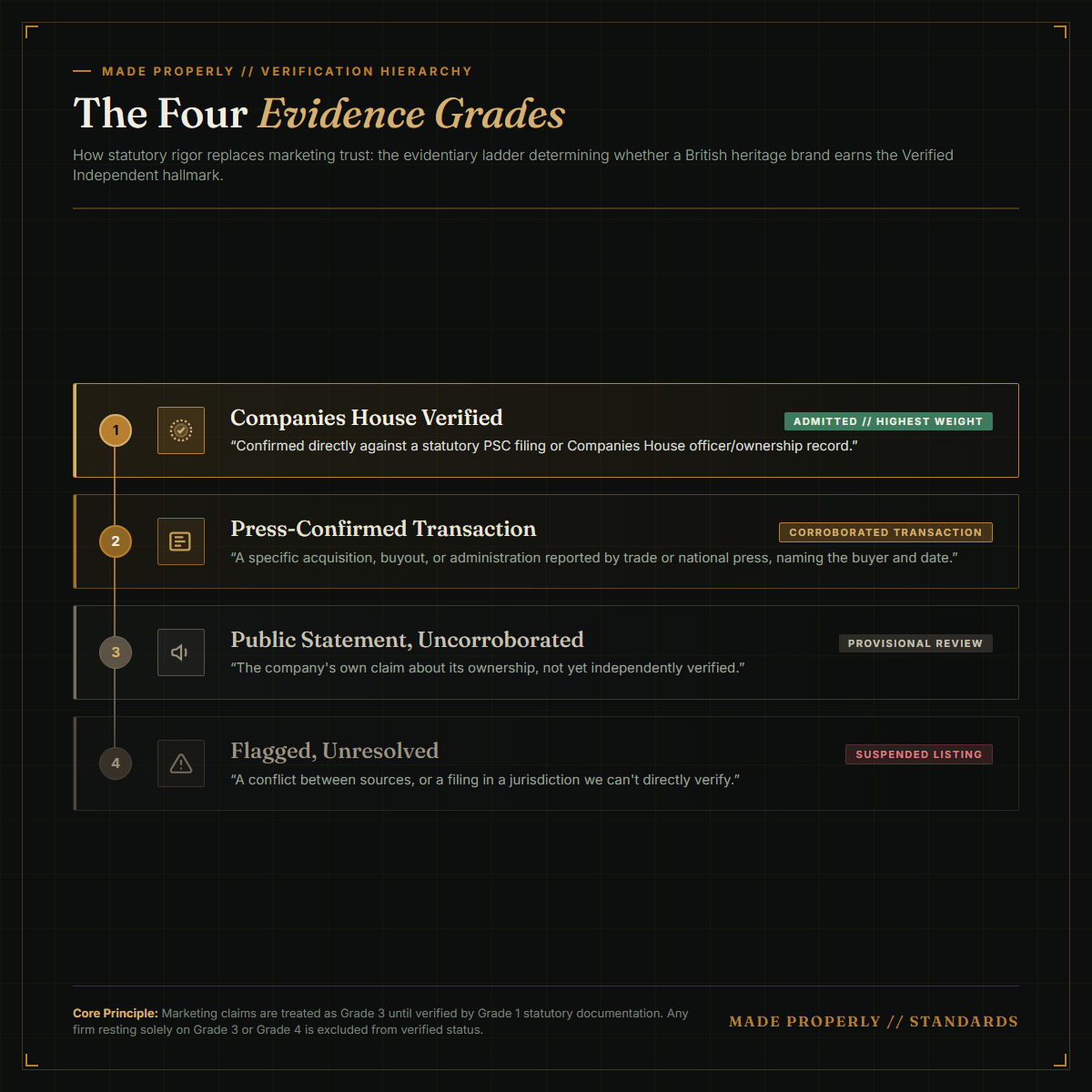
Figure 1: The four-tier evidentiary hierarchy used to verify manufacturer independence on Made Properly.
Borrowing the same discipline we use in the Adulteration Files, every ownership claim in this directory carries an implicit grade, ranked by how much weight it can bear:
| Grade | What it means |
|---|---|
| Companies House Verified | Confirmed directly against a statutory PSC filing or Companies House officer/ownership record. The strongest possible evidence. |
| Press-Confirmed Transaction | A specific acquisition, buyout, or administration reported by trade or national press, naming the buyer and date, even where the underlying filing hasn't yet updated. |
| Public Statement, Uncorroborated | The company's own claim about its ownership, not yet independently verified. Treated as provisional. |
| Flagged, Unresolved | A conflict between sources, or a filing in a jurisdiction we can't directly verify (most often a foreign parent's own home-country registry). Listed with the conflict stated openly rather than resolved by guesswork. |
A firm needs at least Companies House Verified or Press-Confirmed Transaction status to be listed as compliant. Anything weaker gets flagged for further checking before we'll put our name behind it.
What actually disqualifies a firm — worked examples
- Wholly owned subsidiary of a foreign conglomerate. Freed of London (Onward Holdings, Japan), Heathcoat Fabrics (Toray Industries, Japan), Lochcarron of Scotland (E-Land Group, South Korea), Swaine (Chargeurs SA, France), Abraham Moon & Sons (Kvadrat A/S, Denmark, via Wooltex UK) — all confirmed at Companies House Verified or Press-Confirmed level. Removed.
- Majority stake held by a corporate group. Grenson, 75% owned by Castore as of June 2026 — Press-Confirmed via multiple trade outlets. Removed, even though day-to-day creative leadership was reportedly left in place; majority control is majority control.
- Parent company in formal administration. William Mitchell Calligraphy's manufacturing sits inside the Rical Group, which entered administration in January 2025 (confirmed via administrators' filings). Suspended rather than removed, pending resolution.
- Confirmed defunct. Pittards, which ceased trading permanently in September 2023 and remains in administration solely to wind down its estate. Removed — there's no ongoing independent business left to verify.
What does not disqualify a firm — also worked examples
- A management buyout, even from a conglomerate. Cheaney was owned by Prada from 1999 until a 2009 management buyout by the Church family returned it to full independence. Compliant.
- A minority growth-capital investment. Emma Bridgewater took an £8m minority investment from BGF in 2020 and a further £2.2m in 2024; the founder and family retain board control and majority equity. Compliant.
- A change of family to a private syndicate, with the workshop and craft retained. Tricker's moved from five generations of Barltrop family ownership to a private craft syndicate (Blu Heartknot UK) in July 2025. No longer family-owned by its founding line, but not conglomerate-owned either — reclassified, not removed.
- A cooperative that evolved into a private family firm. NPS Solovair was founded as a workers' cooperative in 1881 and has been privately, family-owned since 2006. The label needed updating; the independence didn't.
- A childless founding family succession transitioned to a factory family. When the third generation of the founding Hudson family died out childless in 1982, J. Hudson & Co. (Acme Whistles) was not sold to a conglomerate or private equity firm. Instead, ownership transitioned to Simon Topman (whose father had worked in the factory) and remains 100% independent and family-owned under Simon Topman and his son-in-law Ben McFarlane at the historic Barr Street works in Birmingham. Compliant (Companies House Verified: Company No. 00473291).
Where this method fails, and how we handle it
Foreign parent companies are the hardest cases — their ownership records sit in registries we don't have the same statutory-access relationship with as Companies House. For those we rely on Grade 2 (press-confirmed) evidence, which is solid but not the gold standard we hold UK entities to. Where we can't clear that bar, a listing is marked Flagged rather than either approved or removed, and we say so.
We also got this wrong before publishing this method. Cadbury sat in our own directory for months because an internal content tag, not a person, mistakenly classified an investigative article about its ownership as a maker listing. No verification step caught it, because the error happened upstream of the verification step entirely. Fixing that — and the audit that followed it — is the reason this page exists now.
Check us
If you believe a listing is wrong in either direction — a firm we've removed that shouldn't be, or one we've kept that shouldn't stay — tell us with your source. We'll check it against this same method and correct the record publicly, the same way we're doing here.